well, it's more or less finalized. just a few things to do, server side. click on the image to see a video and more. you can also go here.
here's an excerpt from a description i wrote about it:
"I was in the Marines for a couple of years. I trained to be a machine-gunner in the infantry, but halfway through I woke-up to the reality of my situation. I realized what I was allowing myself to be used for and decided that I couldn't live with that, so I sought a discharge. I am not a violent person, but I have seen within myself the capacity for an unthinking violence that both scares and fascinates me. Violence is one of the heritages of humanity. This game acts as a window for me (and others) to approach this capacity in a socially and physically safe manner.
To underline this ludicrous but seductive dynamic, I modified the existing game so that the rounds continue almost indefinitely, the environment never changes. Both models, the terrorist and the counter-terrorist are wearing me, they embody me as a player of the game. It is not about me fighting myself, it is about seeing myself (ourselves) reflected in this perpetual cycle of violence. One that is as repulsive as it is fascinating."
Tuesday, June 3, 2008
Winning, finished

Clay Shirky on Cognitive Surplus
image from ralphhogaboom's flickr stream
I just finished reading an essay entitled "Gin, Television and Social Surplus" by Clay Shirky and I wanted to post of few excerpts,
"If I had to pick the critical technology for the 20th century, the bit of social lubricant without which the wheels would've come off the whole enterprise, I'd say it was the sitcom. Starting with the Second World War a whole series of things happened--rising GDP per capita, rising educational attainment, rising life expectancy and, critically, a rising number of people who were working five-day work weeks. For the first time, society forced onto an enormous number of its citizens the requirement to manage something they had never had to manage before--free time.
And what did we do with that free time? Well, mostly we spent it watching TV."
"Now, the interesting thing about a surplus like that is that society doesn't know what to do with it at first--hence the gin, hence the sitcoms. Because if people knew what to do with a surplus with reference to the existing social institutions, then it wouldn't be a surplus, would it? It's precisely when no one has any idea how to deploy something that people have to start experimenting with it, in order for the surplus to get integrated, and the course of that integration can transform society.
The early phase for taking advantage of this cognitive surplus, the phase I think we're still in, is all special cases. The physics of participation is much more like the physics of weather than it is like the physics of gravity. We know all the forces that combine to make these kinds of things work: there's an interesting community over here, there's an interesting sharing model over there, those people are collaborating on open source software. But despite knowing the inputs, we can't predict the outputs yet because there's so much complexity."
"We're looking for the mouse. We're going to look at every place that a reader or a listener or a viewer or a user has been locked out, has been served up passive or a fixed or a canned experience, and ask ourselves, "If we carve out a little bit of the cognitive surplus and deploy it here, could we make a good thing happen?" And I'm betting the answer is yes."
there's a lot more to his essay and if this sort of thing interests you, read it.
Sunday, May 25, 2008

Friday, May 23, 2008
Winning
i play counter-strike: source, the most popular online first-person-shooting game and the most perfect example of cyclical, random violence hidden behind a thin veil of purpose. for a long time (ten years) i've played and been fascinated by this game, but unable to make art of out it.
recently, i've been working on a new piece titled Winning. it's a simple idea: make a small room, place two opposing players (computer controlled bots), make it perpetual and see who wins. by removing the pretext of purpose from the game itself, distilling it down to the basic element of communication between the two sides, it very quickly becomes obvious how pointless this state is. one of the bots will win a round, but then the game resets and they play again and again and again. no one wins; because it doesn't end. it just goes on and on.
i had it running, projected on a wall, life size, volume cranked for an hour today. at one point the sheer pointlessness of it was too much and i started laughing like crazy. i had the giggles, the kind that leaves you red-faced and gasping, for 3 or 4 minutes. maybe that's what we're coming to in the world. the point where all of us stop pretending and just start laughing.
jump through this hoop to see more images and a really bad video. i'll get a screencast soon. hopefully i'll be able to exhibit this piece in october, here.

Saturday, May 17, 2008
Tuesday, May 13, 2008
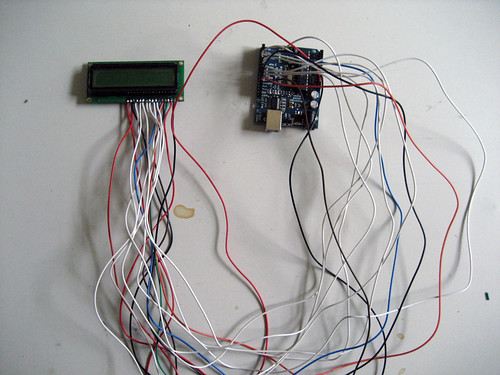
Arduino LCD Knex Twitter
i've been really bad about updating here lately. it's spring, the weather is finally remembering what that means and i've been outside a lot, but not enough. i'm fighting my way through the final 5 weeks before i get to see mon after 6 months of digital substitution. wedding plans are coalescing and it's getting really exciting.
my work has been slow, but this weekend it picked up. some of you may know that i've been working on some kinetic sculptures built from knex. when i say some, i mean, really, just one. i have a smaller prototype and a much bigger (but not big enough, i think) alpha version in which i'm incorporating some of my crazier mechanical ideas. the mechanics of these knex machines are the easy and fun part. construction progresses intuitively and playfully, reminiscent of how i paint. since the outset i've been searching for a way to make these works interactive and/or networked. i've been stumped.
it's been a hard transition for me. going from media-centric, passive art to what i now know is "post-media", active work. but after taking a couple of days off this weekend, i figured it out. i use twitter. twitter is an extremely fascinating example of simple rules spawning a complex system. it asks, "what are you doing" and gives you 140 characters or less to answer. it can be used and accessed through a wide variety of media. it's free. it's open-source, to a point. the api is available for development and hacking. the basic idea is you say what your doing, other people do the same and you can "follow" or subscribe to all the other people twittering. it's like quick n'dirty, stream of consciousness blogging. and it's been used during times of crisis when traditional communication has broken down.
i've decided to incorporate live twitter feeds, via an arduino and lcds, into my kinetic sculptures. largely because i'm starting to see these knex machines as social sculptures. sculptures based on and influenced by cities and society. and twitterfeeds could arguably be called the societal stream of consciousness. i've not thought through them completely yet. i'm still building. i'm still excited. that's gotta be a good sign.